An article inspired by an article!
In early 2022, Harold Lee posted an article titled Buy Things, Not Experiences. It was refreshing!
I wrote something with a similar theme in 2019. But in some ways, I think Harold says it better.
He talks about the philosophy of “buying experiences rather than things” as a form of minimalism, and gets to the heart of it when he says:
“the focus on minimalism sounds like a new form of conspicuous consumption.Now that even the poor can afford material goods, let ’s denigrate goods while highlighting the remaining luxuries that only the affluent can enjoy and show off to their friends.__”
It’s not actually “things” versus “experiences”
Harold states that “In truth, there is no real boundary between things and experiences.”
He notes:
-
“thoughtfully chosen material goods can enable new activities [that] can enrich your life, extend your capabilities, and deepen your understanding of the world.”
-
“tools and possessions enable new experiences.” – for example, a “well-appointed kitchen [can allow] you to cook healthy meals for yourself rather than ordering delivery night after night”.
-
“A toolbox lets you fix things around the house and in the process learn to appreciate how our modern world was made.”
Baumol ‘s cost disease
The expression that we should buy things, not experiences “amounts to saying that in an age of industrialization and globalism, when material goods are cheaper than ever, we should avoid partaking of this abundance.
Instead, we should consume services afflicted by Baumol ’s cost disease, taking long vacations and getting expensive haircuts which are just as hard to produce as ever.”
__ I ❤ the reference to Baumol’s cost disease!
This “disease” happens when some industries become really productive and can justify paying higher salaries to the people who work in that industry. This doesn’t just impact that industry but other industries that don’t have the same productivity gains.
Basically, other industries, which haven’t become more efficient, need to increase the wages they offer to remain competitive in attracting and retaining employees.
This is common in service-driven sectors such as healthcare, education, and tourism, where it is difficult to boost productivity in the same way as other industries. It is part of the reason you see charts like this:
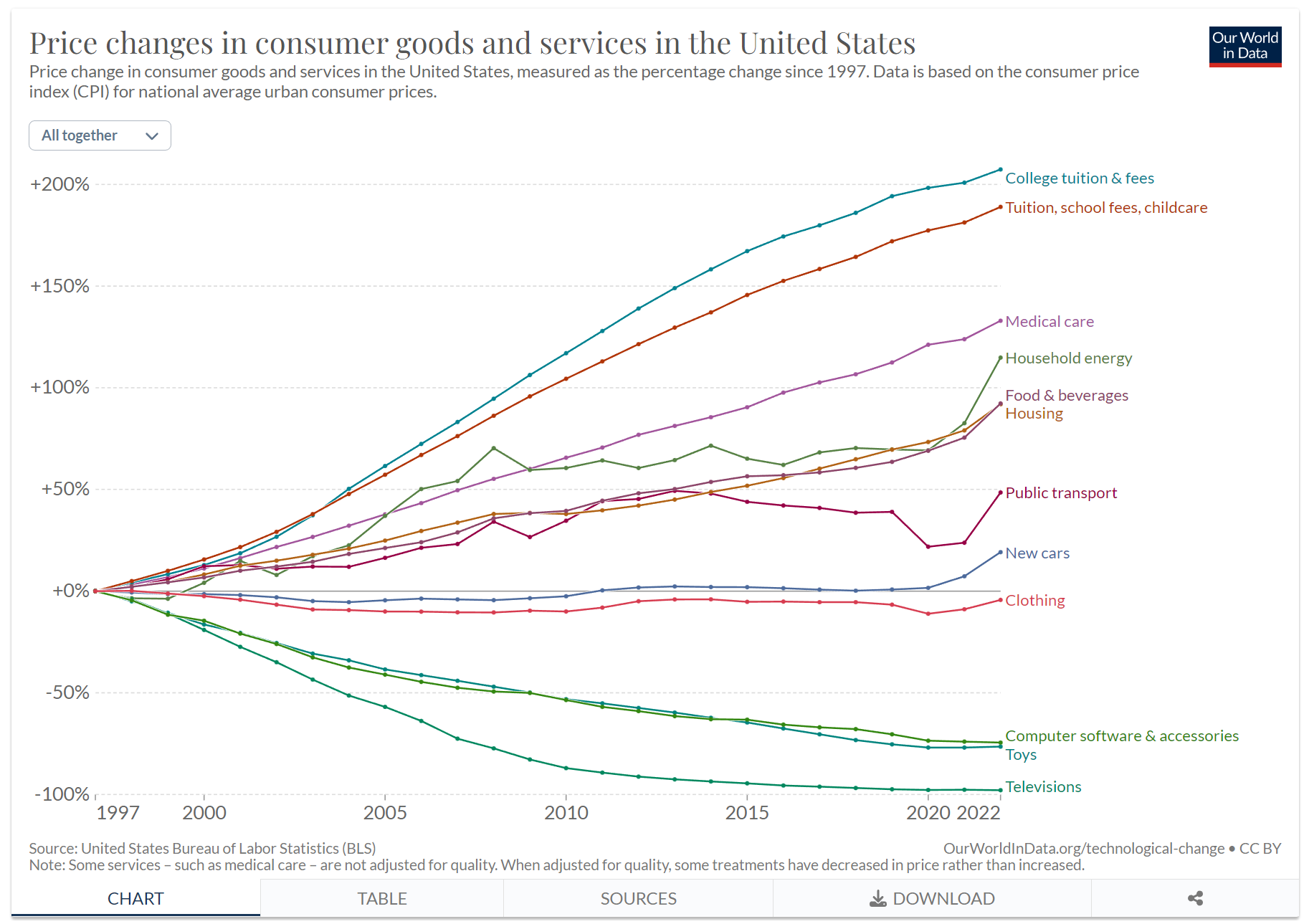
(Source: Our World in Data)
Most experiences involve people, and these people need to be paid. While you can get more for your money with items that can be made more efficiently, these service-focused expenses become relatively more expensive.
I acknowledge that some experiences have psychological characteristics that can be correlated with lots of definitions of happiness. There’s some research indicating that we tend to adapt more quickly to things than experiences. People often spend more time anticipating and remembering experiences than buying things. Experiences are often more unique and don’t lend to comparison as much as things. And experiences are often shared with other people.
But ultimately, these characteristics aren’t unique to “experiences” as a class, and can apply to many “things” as well.
Perhaps, in this article and others, I’ve let the pendulum swing too far in the “buy things” direction. But in part, this is because I think the pendulum has swung too far towards the idea of “buying experiences”. At the end of the day, how we spend money shouldn’t relate to whether the thing we buy is a good or a service, but whether it’s a useful or meaningful way to spend money.